

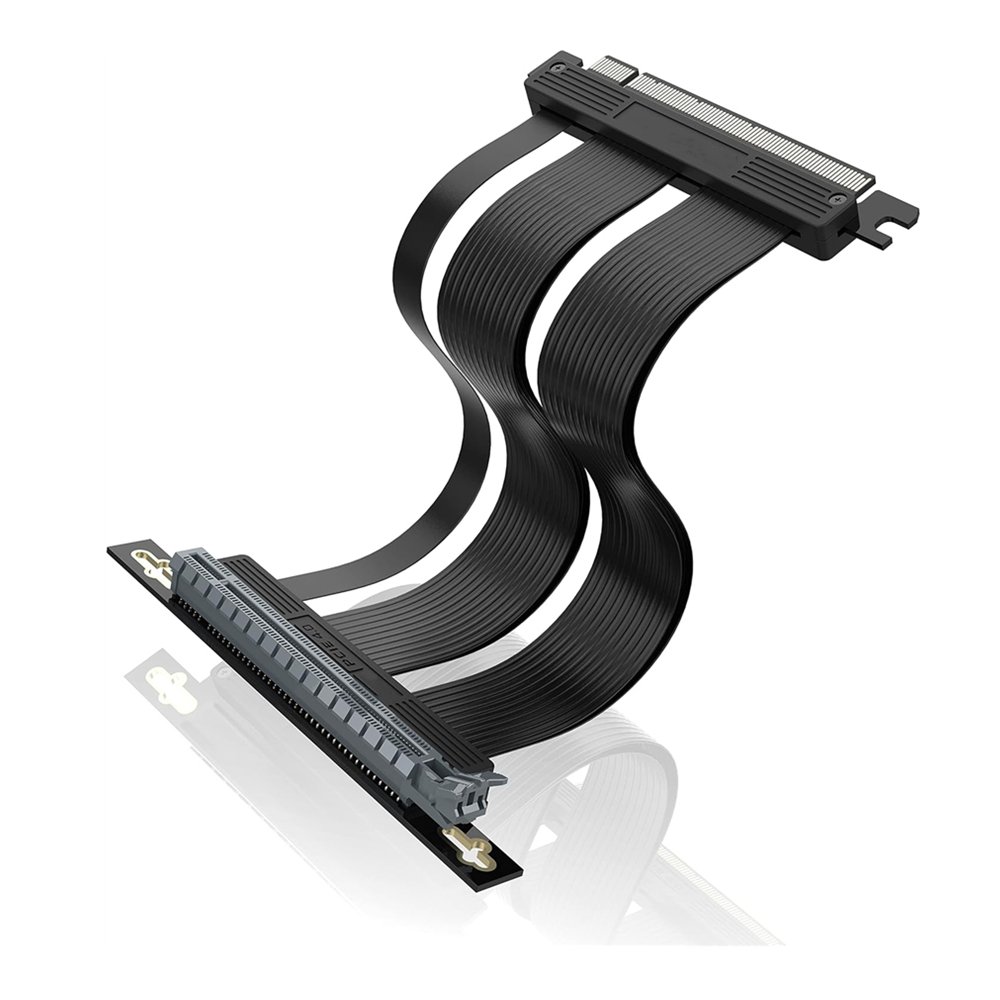
In modern computing systems where space optimization and specialized configurations are of utmost importance, PCIe riser cables provide the essential flexibility to overcome various physical layout constraints. These specialized cables allow graphics cards, capture cards, and almost any form of PCIe device to be positioned away from the motherboard; innovative system designs cannot be achieved without them. Cryptocurrency mining operations (multiple GPUs being a prime example), compact servers maximizing rack density, and an infinite array of other specialized computing environments utilize PCIe riser cables as near-indispensable components.
We manufacture these riser cables to meet the more demanding requirements of professional applications. PCIe 3.0 and 4.0 specifications are strictly followed; signal integrity is maintained over all reasonably achievable lengths, with modern high-speed devices being the primary compatibility concern. x16, x8, and x4 lane configurations are available, each accommodating different (and often overlapping) bandwidth needs. Physical flexibility is the other key aspect of a good riser – high-quality copper conductors and near-perfect impedance matching keep signal degradation to a minimum; graphics cards and, to a large extent, NVMe adapters represent the endpoint of all high-bandwidth performance that these cables are intended to support.
Durability is engineered into the riser itself. Reinforced connectors can take repeated insertion cycles, and frequent small—to medium-scale reconfigurations are common in many systems. Vibration-resistant construction is also a part of our design. If possible, mining-specific setups call for greater EM shielding, though all current versions have at least partial shielding. Lengths are available from 15cm up, and the goal is precise positioning of expansion cards within a chassis.
System integrators and/or OEM clients will always find a place for us—custom or bulk-priced risers are and will remain, to us at least, a significant part of the future of computing systems.
Products By Features


Small Form Factor PC Building
Gamers and enthusiasts in small chassis; users building SFF systems rely on PCIe riser cables to free up space for more powerful builds. These bendable leads made it possible to mount full-size graphics cards parallel to the motherboard, which in turn caused a significant reduction in the system’s overall size. This allows you to have a slight form factor build capable of high-performance while being compatible with all your components, perfect for a portable workstation or public gaming pc.


Vertical GPU Installation and Thermal Optimization
Vertical GPU mounts are of significant interest in computer building, as they can provide cool effects and excellent performance for the graphics card. PCIe riser cable allows this by extending the slot in the motherboard to a mounting bracket. This placement allows for superior airflow around the graphics card and shows off your high-end components through the case side panel, making it one of the best gaming computer cases with fan filters.
Cryptocurrency Mining Configuration
Cryptocurrency miners need many parallel working GPUs, which creates unique spacing issues. PCIe riser cables allow miners to pull their GPUs apart for better airflow, but keep the electrical connections to the motherboard. Using two riser cables supports more efficient arrays, while cooler management would be impossible with conventional PCIe slot spacing for graphics cards.


PCIe Version Compatibility
PCIe 4.0 cables are backward compatible with Gen 3.0 devices, and if that is causing issues like instability, it may be solved by doing DO NOT AUTO in the BIOS and setting the x16 slot to Gen3. Higher-grade riser cables indicate what standards they support to provide signal consistency from generation to generation when high-speed data transmission is required.
Shielding Technique
Preventing signal degradation at high data rates is the primary engineering task of PCIe riser cables. This prevents high-speed signals from being interfered with or corrupted by powerful low-speed tones. Good cables use multiple shielding layers (often combinations of foil and braid) to block ElectroMagnetic Induction, which can degrade those high-speed signals. This conscientious design helps preserve data integrity throughout the extension, not causing errors, poor performance, or system crashes resulting from poorly shielded units.


Connector Quality
The PCIe riser cables’ connectors are often mechanically stressed, especially when a system does a lot of part swapping. The reinforced connector is durable and secure enough for repeated use cycles, and the gold-plated exquisite head makes it ideal. The higher-priced ones have either locks or stiffening brackets to ensure robust mounting and prevent accidental removal.
Customized Length
You can choose from different lengths of PCIe riser cables to fit your case and hardware configuration. From short 10cm cables that are perfect for Mini ITX cases to longer 30cm+ lengths that are highly functional in specialty chassis or larger builds, you can choose interior cabling best suited for your PC. A few provide custom lengths and angled connectors with stringent custom form factors for specific applications.

PCIe 4.0 cables are engineered for higher signal integrity requirements, with doubled bandwidth being the primary factor. They are backward compatible with PCIe 3.0 devices and will operate at that lower specification’s speed when used with them.
Yes, backward compatibility is built into PCIe riser cables. The card will stay within its designed lane configuration if needed, physically fitting the x16 connector.
We recommend under 25cm for PCIe 4.0 applications and 50cm for 3.0. Optimal performance is the end goal.
Our cables follow standard PCIe specifications—any motherboard with standard slots will work. Specific device-related compatibility issues are rare, and cable-related ones are nearly non-existent.
High-quality cables (ours being a prime example) maintain near-perfect signal integrity. Cheaply made risers cause various degradation; stability and/or bandwidth will suffer.
We do not recommend it. Longer reaches should use our custom length solutions instead.
Mining-specific versions have the added EMI shielding we mentioned previously, with continuous operation being a primary concern.
Yes, all our current and future riser cables will have at least one orientation (or both) of some form.
We see graphics as a very high-bandwidth and/or signal-intensive workload. Mining and/or gaming are all well within the limits of our current and future cables. Custom or not, we believe in quality and/or performance-based riser cables.
Our minimum order is still 100+ units.

